
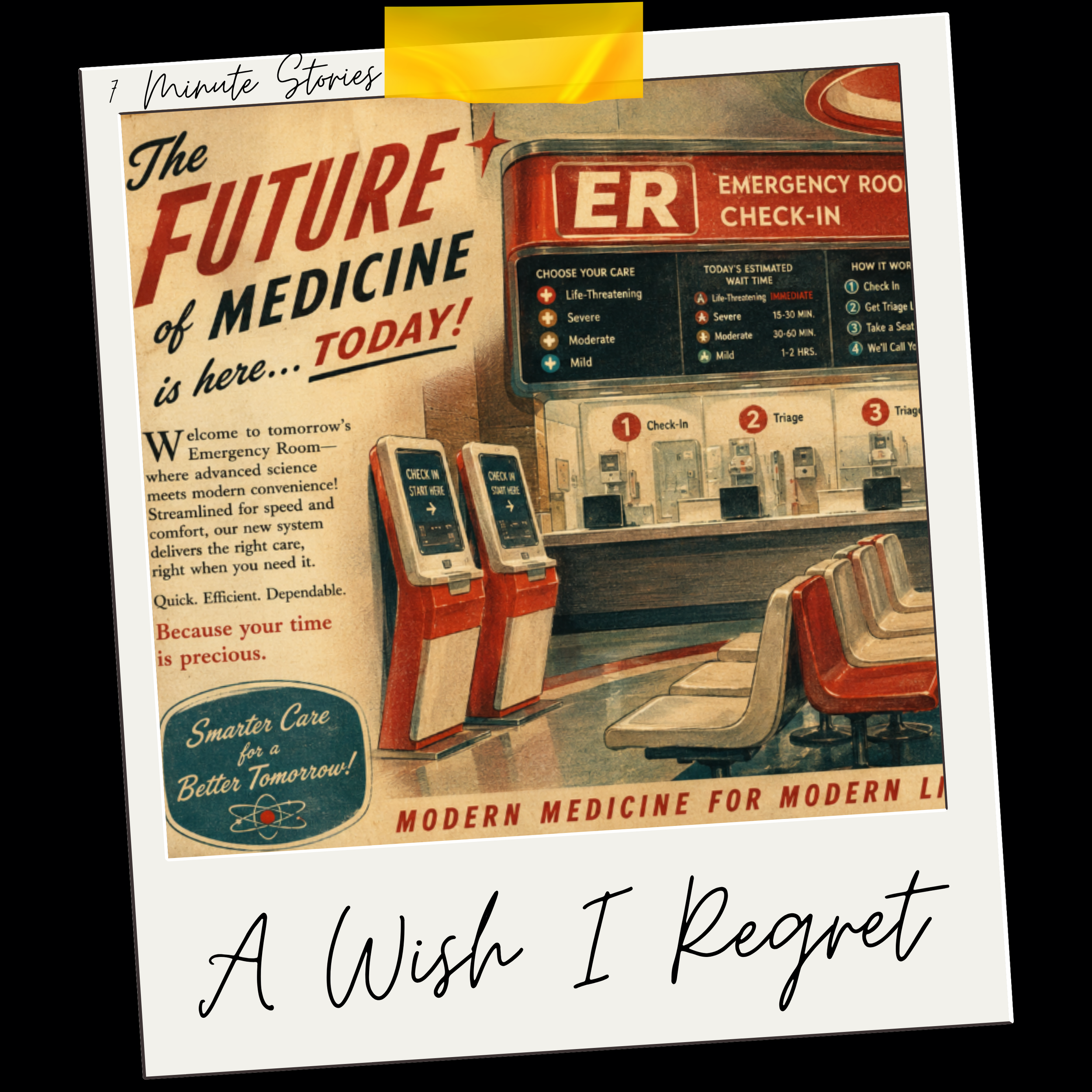

An exhausting night in the emergency room pushes Aaron to make an impulsive wish: what if healthcare workers were replaced by AI? But when a quiet moment with a triage nurse changes everything, he’s forced to reconsider what efficiency might cost us. A story about frustration, humanity, technology, and the unexpected comfort of being cared for by another person.
📬 Be a part of the 7 Minute Stories Newsletter
Once a month, you’ll receive a thoughtful note with storytelling insights, behind the scenes reflections, and exclusive bonus content. You’ll also have access to Stories in a Snap, his weekly short written adaptations of the 7 Minute Stories you love, reimagined for the page and delivered straight to your inbox via Substack with no algorithm in between.
*Dive deeper into the 7MS Universe and connect with Aaron on...
The Team:
Story created & performed by: Aaron Calafato
Senior Audio Engineer: Ken Wendt
Additional vocals: Cori Calafato
Art: Pete Whitehead
Original Theme Music: thomas j. duke
Additional Soundscape Design: Isaac Gehring
Follow & Binge The 7MS Catalog
TRANSCRIPT
I made an impulsive wish.
It was in the heat of the moment. I was frustrated. It was a quiet one. It wasn’t quite a prayer, but it was something I said between myself, my grandmother, and my wife, Cori.
All three of us were sitting in the emergency room waiting area.
I’m going to tell you what that wish was, and I’ll take you to the very moment where I realized how grateful I was that it didn’t come true.
All of this right after the music.
I’ll just start here.
Bottom line, the emergency room experience, for everyone, healthcare providers, patients, across the board, I think we can all agree that it can get better.
Sometimes I swear there are people who just roll the dice and don’t go to the ER, not because they don’t need care, or maybe they should seek care, but because they don’t want to endure the amount of time it’s going to take just to see somebody.
You roll up at 8 p.m., and you may not get in to see a triage nurse until midnight. I always say to myself, “You may not be there if it’s a real emergency. You might be dead.”
I think it’s the wildest thing.
But I also know that it’s complicated. There’s nothing easy about this experience. One, being in need, and then also providing care, especially when there are limitations with staff and rooms and all this stuff.
Human need is so great.
I don’t know if that speaks more to the operational side of things or just the reality of what it is to be human beings who need stuff, especially when it comes to our survival.
My grandmother is in her early 90s, and she fell. It was rough, so we took her to the ER to get looked at.
When we got there, there were maybe five or six people, but we were there for over an hour just waiting.
But this is important because she’s at an age now where life is even more fragile than ever, and we want to make sure she’s taken care of.
And in the middle of all this, I’m getting pissed. I’m starting to pace.
Patience.
I’m losing patience.
I was hangry.
I go down to the vending machine, which is way down this hallway. Huge hallway. Big infrastructure. It’s more building than patients and doctors and nurses and medical assistants. Just a giant space with only a portion of it being used for the healthcare stuff.
But I find the vending machine, and I put the little number in. I put like ten bucks in just to get a couple bags of chips and three bottled waters because at this point, my grandmother’s got the emergency, but I’m starting to feel dehydrated.
So I put the money in. All of a sudden, the vending machine’s spinning, and nothing’s coming out.
I start pounding the machine, but I know the end of this story.
So I start walking down the hallway, and after over an hour and a half, when I’m walking back to the emergency room waiting area, I see my grandmother getting wheeled away by my wife.
I go, “Wait, wait, I’m coming. I waited this long. I’m coming.”
I finally catch up empty handed, and as we’re walking in to do the triage, they stop us and say, “Whoops, sorry. We thought you were someone else. You have to wait longer.”
At this point, I’m trying not to become a caricature. I’m practicing my breathing. I’m saying a prayer. I’m fighting against the lizard part of my brain.
Be better, Aaron. Be better. Don’t turn into this person. Don’t be angry. Stay in the moment. See the beauty.
I’m trying, and I’m having some moments, but it’s a struggle.
We sit back down, and then I say it.
I go, “I wish all these medical assistants, I wish the triage nurse, I wish they were all AI. You know why? Because at least they could come out, and it would be efficient.”
I want someone to come out on some wheels, like in Rocky IV, and go, “Happy birthday, Paulie.”
No, I want them to come out and say, “Are you Aaron? Is this your grandmother?”
“Yes, it is.”
And then I talk to a screen. I press some buttons, and then boom, bing, bow. Messages are sent. Electrical signals are pushed. We’re put into a queue. We’re moving. It’s like an app.
Next thing you know, it’s like DoorDash. Bing, food arrives.
I want this to be the case.
Now, as soon as I utter the wish, all of a sudden, the triage nurse comes out.
“Ready to come back?”
“Yeah. Sure we are.”
I’m mad.
Cori wheels my grandmother. We go into the triage area. At this point, I’m defensive. I’m thinking, “Here we are, finally. Took an hour and forty five minutes. Man, if we had some computers running this, I mean, it could be a lot more efficient.”
I had this in me. It’s palpable.
And I’m talking myself down like, “Yo, she’s just meeting you for the first time. Relax, bro.”
I’m working through this Hamlet style.
To be or not to be, that is the question.
She asks my grandmother a series of questions. She didn’t need all the backstory. She didn’t need all the details.
But my grandmother was getting into the weeds because she was tired and exhausted, and I needed to step in and help tell this story quickly and efficiently so we could get her the care she needed.
And the first thing I start doing, and by the way, Cori is the master at this, I start making jokes.
I don’t know about you, but when I get into the ER or urgent care, I become a stand up comedian.
You should see Cori. She’s there, going through bits and making the nurse laugh. It’s almost like we’re trying to convince them there’s not an emergency, whether it’s someone else or us, or even that we should be seen.
We’re sitting there trying to make them happy. We’ve got the issue. We’re making them laugh.
I don’t know where that comes from, but I start going into that mode.
And she kind of reins me in and goes, “Just walk me through what’s going on with your grandmother.”
I go, “Well, yeah, that’s why we’re here. Okay, so…”
And I lay out the story, beginning, middle, and end. Important details, important moments, important variables.
And she looks at me and goes, “Great. Thank you so much. It was so clear. I needed that. Here’s what we’re going to do. Bing, ba, boom, ba, ba.”
And she looks at my grandmother and goes, “We’re going to get you taken care of, okay? I got you in a nice room, and it’s right across the way from the bathroom.”
And I realized it wasn’t just my grandmother who needed it.
I needed a human to be there.
It would have been more efficient, maybe, with a computer screen or whatever. But that screen, that AI replicator, that replicant, that LLM, that thing, it could sound like us, feel like us, but I would know that it’s not like me.
And when that nurse looked at me with clarity and certainty, but vulnerability, and she was real, that’s what I needed in that moment to help make sense of this whole thing and to give my grandmother a sense of relief.
And the other thing that’s interesting is I think one of the reasons why we were waiting so long was because my grandmother is in her 90s, and they were prioritizing a room that was better for her without us even asking.
That’s something that feels human and less optimal.
That was the moment I realized I shouldn’t have made the wish.
And that was the moment I realized I’m so glad, at least that day and that moment, that it didn’t come true.
But there are a lot of moments, and there’s a huge runway of time and a continuum we’re moving on, and it could be the case that something like that does come true.
And I wonder, in those moments, as we efficiently get moved in and out like chicken nuggets out of the healthcare facilities and into the care that we need, that we might be healthier, but maybe feel less human in the process.
Oh, and Grandma, Gma, she’s doing better and she’s kicking butt.
And thanks to all the doctors and nurses who helped us along the way.
I’ll talk to you next week.