
Listen Free: | Apple Podcasts | Castbox | Pandora
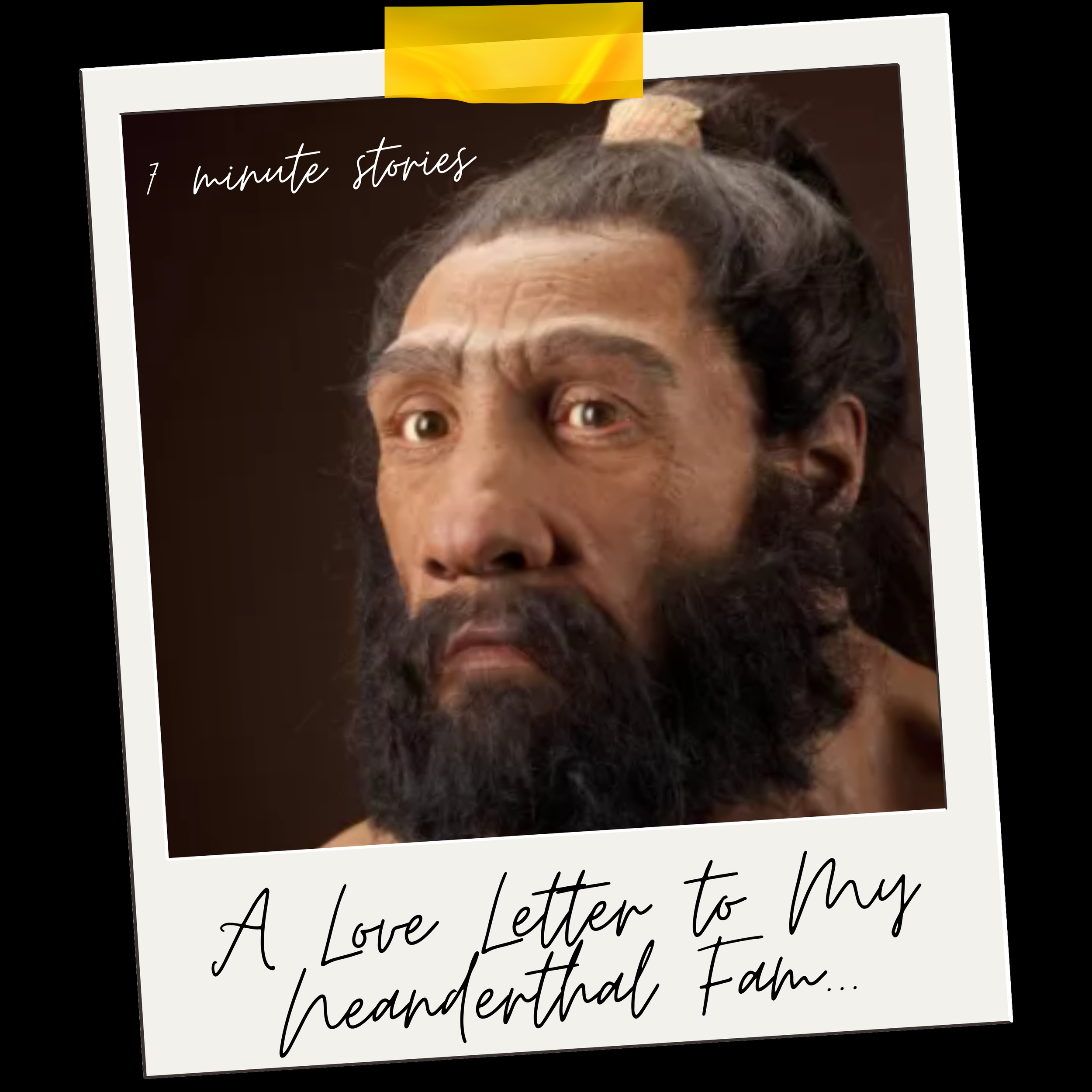
In this 7 Minute Story, Aaron (inspired by the NOVA Humans docuseries from PBS) discovers an unexpected kinship with his Neanderthal ancestors — not as cartoon cavemen, but as real people whose lives shaped our own. Through humor, identity, and deep-time storytelling, he explores what survives, what disappears, and why a tiny percentage of ancient DNA still carries meaning today. A funny and surprisingly emotional journey into who we are, who we come from and 'who' is still a part of us!
*Join Aaron Thursday Evenings for Night Stories LIVE! : A live, audio-first show inspired by classic late-night radio — it features raw reflections, spontaneous storytelling, and unexpected conversations with guests and listeners. Subscribe and hit the notification bell on Aaron’s YouTube Channel to tune in!
*Dive deeper into the 7MS Universe and connect with Aaron on...
The Team:
Story created & performed by: Aaron Calafato
Senior Audio Engineer: Ken Wendt
Additional vocals: Cori Calafato
Art: Pete Whitehead
Original Theme Music: thomas j. duke
Additional Soundscape Design: Isaac Gehring
TRANSCRIPT
A Love Letter to My Neanderthal Family
7 Minute Stories with Aaron Calafato
Everybody’s looking for their tribe. Well, guess what? I think I found mine. Here’s the catch — they’re not human. Well… not human as we know it, not Homo sapiens.
There’s a lot to unpack in the next seven minutes, so take this journey with me. Maybe you’ll learn a little more about your own humanity along the way.
It started like an epiphany. You could ask my wife, Cori — I was stunned, transfixed. I had to binge every episode of this documentary series called Humans from NOVA on PBS. And watching it felt like rediscovering not just what it means to be human, but something specific about me.
I always thought certain quirks were because I was Midwestern — and maybe some of it is. I thought it was a Northeast Ohio or Cleveland thing — and maybe some of it is. I figured the Italian American part explained the rest. Or maybe it was the Indiana farmer vibe from my mom’s side. Even physically, I’m looking more and more like a Lego brick. I might be Italian American, but lately I look like a guy who grew up detasseling corn.
My point is: it could be all of those things. But while watching this documentary, I realized… maybe, just maybe, it’s also because I’m a Neanderthal.
And hold up — that’s not a bad thing. Neanderthals get a terrible rap. They’re mocked in cartoons and pop culture as dumb cavemen. But they were so much more.
Let’s take a quick trip back in time. Neanderthals lived in Europe, the Middle East, and western Asia. That was their home turf. They survived Ice Age conditions better than anyone. When the world froze, they were the champions of survival. They were a type of human — not Homo sapiens — but still human.
And they had traits I relate to deeply.
They thrived in tight-knit social groups. That’s how I roll. My family and I move as a pack. I open my orbit, sure, but my foundation is tight and strong. Neanderthals lived that way too.
They were specialists — skilled hunters, master toolmakers. And in my own life, I’m a specialist. I tell stories. That’s my lane. Try to get me to organize a calendar? Disaster. Ask my wife — she’s a lifesaver. I try to juggle too many things at once and my brain fries. But one-on-one, in conversation, in a story? I’m alive. I’m that situational extrovert many of you know well.
And then there’s the cold. Neanderthals thrived in the cold. So do I. Longtime listeners know this. Just this week at the Drug Mart here in northeast Ohio, the cashier said, “I can’t wait until spring.” I told her, “Ma’am, this is my spring.” In the summer, my family wonders if I’m going to make it. And now I’m wondering why. It feels like I was built for winter.
So where are we going with this?
Around 70,000 years ago, modern humans left Africa and spread across the world. That’s when Homo sapiens met Neanderthals. Two big things happened. First: competition for resources. Second: love. Or at least… survival-based intimacy. Either way, there was interbreeding.
Between about 65,000 and 47,000 years ago, humans and Neanderthals mixed multiple times. And then, around 40,000 years ago, Neanderthals disappeared.
Why did this hit me so hard? I’m watching this documentary, crying — no joke — hearing about how their populations dwindled. How climate shifts strained their food. How specialists like them couldn’t adapt fast enough when the environment changed. Meanwhile, Homo sapiens — the generalists — could survive just well enough to evolve.
And when I’m watching what they endured — the terrible things they faced, the terrible things they sometimes had to do — it hit me:
They were people. Maybe a little different, but still people.
And now they’re gone.
Biologically. Materially. They’re temporary.
I’m temporary.
You’re temporary.
One degree of tilt in the Earth, one shift in climate, one change in the ocean — and everything we’re made of could be gone. Now, the energy, the soul, the spirit — that’s another conversation. But biologically, the Neanderthals vanished.
And I found myself asking: all that inertia, all that hope, all that desire to live — where did it go? Out into the void? Into nothing?
I felt so defeated for them. Because all of it was gone.
Or… was it?
Because in a strange way, the Neanderthals found a way to survive. And it wasn’t by clinging on at the end. It was by taking a risk outside themselves — for intimacy, for connection, for life. They didn’t just die out. They were absorbed.
The fact is: people today with ancestry outside Africa still carry one to four percent Neanderthal DNA from those encounters. A little piece of them still lives in so many of us.
And after watching that documentary, feeling all of this, I thought: these are long-lost family members. And honestly? I think I’m pushing the 10 to 15 percent ratio — and I’m damn proud.
I’ll talk to you next week.
